PROJECT: TRUMP-CLASS

HEAVY KINETIC STRIKE VESSEL

Closing the Strategic Gap. Mach 5+ Global Reach.

STRATEGIC OVERVIEW

The Capability Gap: The United States requires the ability to deliver heavy bunker-busting payloads over 5,000 km in under 10 minutes. Relying on vulnerable, slow-moving strategic bombers (like the B-2) requiring extensive aerial refueling introduces unacceptable delays and risks.

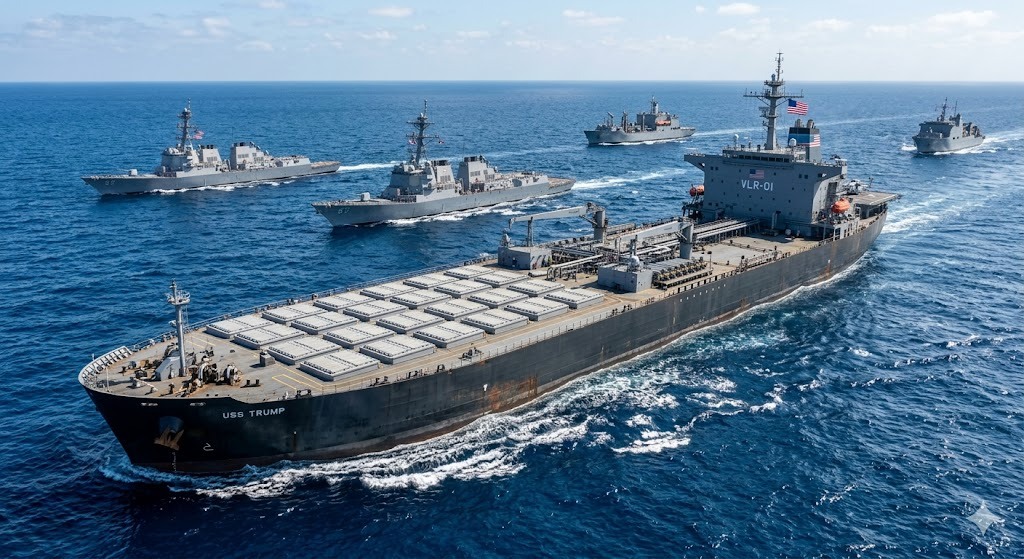
The Solution: The TRUMP-Class Heavy Missile Cruiser. Built on a cost-effective, commercially proven supertanker hull, this vessel acts as a mobile, high-capacity launch platform. Stationed safely outside enemy Anti-Access/Area Denial (A2/AD) zones, it provides immediate, zero-warning strike capabilities.

USS TRUMP Class Cruiser Render

Concept Render: TRUMP-Class Heavy Missile Cruiser (VLR-01)

TECHNICAL PARADIGM SHIFT

Solid-Fuel Architecture

Eliminated volatile liquid fuels. The ship relies entirely on solid-propellant cells integrated into standard VLS modules. Zero fueling delays. Ready to fire.

Kinetic Overmatch

Replaced bulky 13-ton explosive warheads with 1-3 ton Mach 5+ kinetic penetrators. Speed translates to devastating bunker-busting power, enabling twice the missile capacity per hull.

Dual-Use Potential

While optimized for military strike, the massive silo capacity and stable equatorial launch potential offer civilian applications, such as rapid orbital insertion for satellite replacement.

COST ANALYSIS

Item Estimated Cost (USD) Notes
Total Platform Cost ~$300 Million Fraction of a standard Arleigh Burke-class destroyer (~$2B+).
Commercial Tanker Hull $150M - $180M Aframax/Suezmax derivative. High durability, low acquisition cost.
VLS Integration $70M Scaled arrays. Minimal moving parts.
C4ISR Network $50M Off-board targeting reliance keeps ship systems affordable.
Kinetic Missile (Per Shot) $8M - $15M Solid-fuel IRBM. Massively cheaper than a strategic bomber sortie.

INDUSTRIAL BASE & SUPPLIERS